Syed Haider Raza Alias S.H. Raza (born 22 February 1922) is an Indian artist who has lived and worked in France since 1950, but maintains strong ties with India.[1]
His works are mainly abstracts in oil or acrylic, with a very rich use of color, replete with icons from Indian cosmology as well as its philosophy.[2][3] He was awarded the Padma Shri and Fellowship of the Lalit Kala Akademi[4] in 1981, Padma Bhushan in 2007,[5] and Padma Vibhushan in 2013.[6]
After the introduction of 'Bindu' (a point or the source of energy), he added newer dimensions to his thematic oeuvre in the following decades, with the inclusion of themes around the Tribhuj (Triangle), which bolstered Indian concepts of space and time, as well as that of 'prakriti-purusha' (the female and the male energy), his transformation from an expressionist to a master of abstraction and profundity, was complete.[17]
The unique energy vibrating with colour in his early landscapes are
now more subtle but equally, if not more, dynamic. Raza abandoned the
expressionistic landscape for a geometric abstraction and the 'Bindu'.[4]
Raza perceives the Bindu as the center of creation and existence
progressing towards forms and colour as well as energy, sound, space and
time.
His work took another leap in 2000, when he began to express his increasingly deepened insights and thoughts on Indian spiritual, and created works around the Kundalini, Nagas and the Mahabharat.[21]

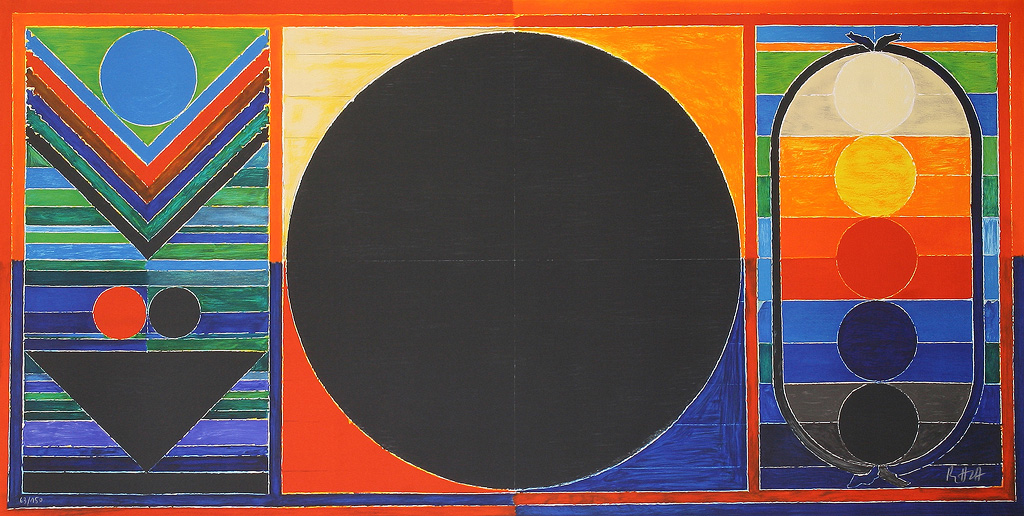


More of the serie Bindu by Raza
His works are mainly abstracts in oil or acrylic, with a very rich use of color, replete with icons from Indian cosmology as well as its philosophy.[2][3] He was awarded the Padma Shri and Fellowship of the Lalit Kala Akademi[4] in 1981, Padma Bhushan in 2007,[5] and Padma Vibhushan in 2013.[6]
The 'Bindu' and beyond
By the 1970s Raza had grown increasingly unhappy and restless with his own work and wanted to find a new direction and deeper authenticity in his work, and move away from what he called the 'plastic art'. His trips to India, especially to caves of Ajanta - Ellora, followed by those to Benaras, Gujarat and Rajasthan, made him realise his ro and study Indian culture more closely, the result was 'Bindu',[21] which signified his rebirth as a painter.[22] The Bindu came forth in 1980, and took his work deeper and brought in, his new-found Indian vision and Indian ethnography. One of the reasons he attributes to the origin of the 'Bindu', have been his elementary school teacher, who on finding him lacking adequate concentration, drew a dot on the blackboard and asked him to concentrate on it.[23]After the introduction of 'Bindu' (a point or the source of energy), he added newer dimensions to his thematic oeuvre in the following decades, with the inclusion of themes around the Tribhuj (Triangle), which bolstered Indian concepts of space and time, as well as that of 'prakriti-purusha' (the female and the male energy), his transformation from an expressionist to a master of abstraction and profundity, was complete.[17]
| “ | "My work is my own inner experience and
involvement with the mysteries of nature and form which is expressed in
colour, line, space and light". - S. H. Raza |
” |
His work took another leap in 2000, when he began to express his increasingly deepened insights and thoughts on Indian spiritual, and created works around the Kundalini, Nagas and the Mahabharat.[21]


More of the serie Bindu by Raza

No comments:
Post a Comment