Tuesday, 16 December 2014

The essence and the need to overcome it for the project
Bindu is beyond the senses and thoughts: It is very important to understand that the actual Bindu is far beyond the senses and thoughts in the conventional sense of thinking processes involving strings of words, images, or other such impressions. This means transcending not only the senses as operating through the physical organs, but also the inner or mental experience of sensation. For example, one not only closes the eyes, but also goes beyond all manner of inner visualization. When attention on all of the Gross and Subtle objects and processes collapses, so to speak, and thus, moves inward towards the Bindu, there is a convergence on a point, which is the finer meaning of one-pointedness of mind. There may be an extremely intense awareness of the nature of pure sound and light, but this is very different from what we experience by mental visualization or imagination. The journey to the Bindu starts to become the experience of the source of light (Jyotir Bindu / Tejo Bindu) and the source of sound (Nada Bindu), as well as being the source out of which other sensation, mental processes, and the instruments of mentation emerge.
This is an important point, girls, because we are aware of this, but we would attempt to "translate" Bindu into something, such as the paintings.
The Bindu at the center of the Sri Yantra symbolizes the final union of Shiva and Shakti (the static and active), the Absolute Reality that is to be realized.
I think we can play with this idea of static and active
The roundness
Bindu as a reaching point
Circle/pearl as a symbol

Circle/pearl as a symbol
the Mustard Seed
Bindu means Point or Dot, is sometimes likened to a Pearl, and is often related to the principle of a Seed.
The Sanskrit root of Bindu is to break through or to burst through.
MEDITATION IT'S A CIRCULAR PROCESS TOO
The good news is that at the Advanced end of the spectrum, we return to simplicity, but of a much higher order. We come to see that all material objects are made only of fundamental elements of earth, water, fire, air, and space (and the more primal elements or gunas of sattvas, rajas, and tamas). We come to see beyond the vast contents of mind, to the fact that the instruments of mind and senses are not really so complex after all.
Convergence and divergence merge
The Dot as a symbol: The Point or Dot has been widely used as a symbol for the way in which the unity or unmanifest coexists at all times and places with the gross, external, or manifest worlds.

Cross: The Point or
Dot has also been used as a symbol of unity emerging through four lines
to form the appearance of two lines crossing. The journey inward is
merging back into the point.
 | |
Yin-Yang: The Dot shows two fundamental forces of static and active, with the seed of one permeating the other, manifesting as the symbolic 10,000 things, while ever remaining one.
| |

Dot and Crescent: The Point and the Crescent is an ancient symbol of the unmanifest point and the manifest reality, later seen as a five pointed star and crescent.
| |

Light and a Tunnel: People having near-death experiences may report seeing light at the end of a Tunnel. The Tunnel is the subtle channel called Brahma Nadi and the light emerges from Bindu.
| |

Hub of a Wheel: The ever still Hub of the Wheel symbolizes the Self (Atman) and the spokes are the Four Functions of Mind (Manas, Chitta, Ahamkara, Buddhi) engaging the outer world.
| |

OM Mantra: The dot at the top of the OM symbolizes Turiya, the Absolute Reality, or Pure Consciousness. OM is suggested in both the Yoga Sutras and Vedanta. (Described in greater detail below)
| |

Sri Yantra: The highest, most advanced symbol of Tantra has a Dot orBindu in the center, which also symbolizes this point of divergence and convergence. (Explained further below)
| |

Mustard Seed: The mustard seed has been widely used as a symbol of the smallest point, out of which the largest emerges, and to which that largest returns. (Discussed below)
|
Residencies
La Macina Artist's Residency
This one closes very soon, so we nees to decide if we want to apply for it. Also we need to talk about the migratory requeriments of each of us. How the situation is according to our nationalities.
This one closes very soon, so we nees to decide if we want to apply for it. Also we need to talk about the migratory requeriments of each of us. How the situation is according to our nationalities.
S. H. Raza
Syed Haider Raza Alias S.H. Raza (born 22 February 1922) is an Indian artist who has lived and worked in France since 1950, but maintains strong ties with India.[1]
His works are mainly abstracts in oil or acrylic, with a very rich use of color, replete with icons from Indian cosmology as well as its philosophy.[2][3] He was awarded the Padma Shri and Fellowship of the Lalit Kala Akademi[4] in 1981, Padma Bhushan in 2007,[5] and Padma Vibhushan in 2013.[6]
After the introduction of 'Bindu' (a point or the source of energy), he added newer dimensions to his thematic oeuvre in the following decades, with the inclusion of themes around the Tribhuj (Triangle), which bolstered Indian concepts of space and time, as well as that of 'prakriti-purusha' (the female and the male energy), his transformation from an expressionist to a master of abstraction and profundity, was complete.[17]
The unique energy vibrating with colour in his early landscapes are
now more subtle but equally, if not more, dynamic. Raza abandoned the
expressionistic landscape for a geometric abstraction and the 'Bindu'.[4]
Raza perceives the Bindu as the center of creation and existence
progressing towards forms and colour as well as energy, sound, space and
time.
His work took another leap in 2000, when he began to express his increasingly deepened insights and thoughts on Indian spiritual, and created works around the Kundalini, Nagas and the Mahabharat.[21]

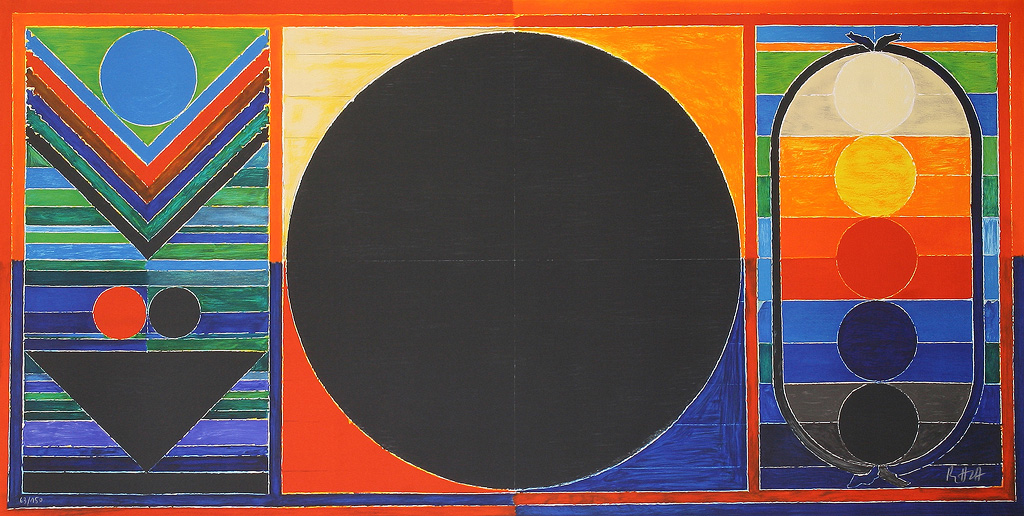


More of the serie Bindu by Raza
His works are mainly abstracts in oil or acrylic, with a very rich use of color, replete with icons from Indian cosmology as well as its philosophy.[2][3] He was awarded the Padma Shri and Fellowship of the Lalit Kala Akademi[4] in 1981, Padma Bhushan in 2007,[5] and Padma Vibhushan in 2013.[6]
The 'Bindu' and beyond
By the 1970s Raza had grown increasingly unhappy and restless with his own work and wanted to find a new direction and deeper authenticity in his work, and move away from what he called the 'plastic art'. His trips to India, especially to caves of Ajanta - Ellora, followed by those to Benaras, Gujarat and Rajasthan, made him realise his ro and study Indian culture more closely, the result was 'Bindu',[21] which signified his rebirth as a painter.[22] The Bindu came forth in 1980, and took his work deeper and brought in, his new-found Indian vision and Indian ethnography. One of the reasons he attributes to the origin of the 'Bindu', have been his elementary school teacher, who on finding him lacking adequate concentration, drew a dot on the blackboard and asked him to concentrate on it.[23]After the introduction of 'Bindu' (a point or the source of energy), he added newer dimensions to his thematic oeuvre in the following decades, with the inclusion of themes around the Tribhuj (Triangle), which bolstered Indian concepts of space and time, as well as that of 'prakriti-purusha' (the female and the male energy), his transformation from an expressionist to a master of abstraction and profundity, was complete.[17]
| “ | "My work is my own inner experience and
involvement with the mysteries of nature and form which is expressed in
colour, line, space and light". - S. H. Raza |
” |
His work took another leap in 2000, when he began to express his increasingly deepened insights and thoughts on Indian spiritual, and created works around the Kundalini, Nagas and the Mahabharat.[21]


More of the serie Bindu by Raza
Ideas
I haven't found exactly what I want to show, but I'll post some projects which work with similar platforms I told you. I think we can use this "ideas" as a starting point. I'd like to develop with you an intelligent way of questioning the visibility/invisibility of bindu.
http://www.adafruit.com/blog/2014/06/19/kinect-powered-animation/
http://www.adafruit.com/blog/2014/05/27/sand-noise-device-from-maker-faire-bay-area-2014-arttuesday/
http://www.adafruit.com/blog/2014/06/19/kinect-powered-animation/
http://www.adafruit.com/blog/2014/05/27/sand-noise-device-from-maker-faire-bay-area-2014-arttuesday/
Monday, 15 December 2014
POINTS TO EXPLORE
- This artickle talks about the convergence of Bindu in the three streams of Yoga, Vedanta, and Tantra. I found it very interesting, because as far as I know 3 of us are currently interested in each of this streams. Iliana found herself in yoga. Surabhi was researching and practicing Tantra. And I am all into Vedanta (in Advaita Vedanta, to be clear). So I found this to be a sign that we are on the right path) as we could develop this further.This is one of 10 aspects I would like to suggest from my side. Bindu as a focal point of this 3 philosophies.
Bindu is...
- a stage of Yoga Meditation
in which all experiences collapse, so to speak, into a point
from which all experiences arose in the first place.
- near the end of the subtlest aspect of mind itself, after which one
travels beyond or transcends the mind and its contents.
- near the
end of time, space, and causation, and is the doorway to the Absolute.
- is the convergence point of Meditation,
Contemplation, Prayer, and Mantra, and is part of the mystical, esoteric aspect of
many, if not most religions and meditative traditions.
- an actual, internally experienced reality.
Sunday, 14 December 2014

Subscribe to:
Comments (Atom)